The USC Trojans have made some changes to their coaching staff.
Offensive line coach Tim Drevno and strength coach Aaron Ausmus were let go by head coach Clay Helton.
The Daily News’ Scott Wolf reported the news and added that Helton
James Skalski was ejected from the Sugar Bowl playoff game between his Clemson Tigers and the Ohio State Buckeyes on Friday for targeting.
Ohio State had a 3rd-and-13 in the second quarter leading 21-14. Justin Fields took off for a run af
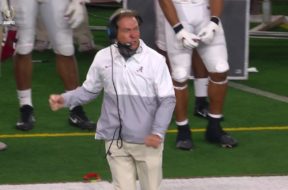
Alabama coach Nick Saban was angrily berating his players on the sideline late in Friday’s College Football Playoff semifinal, even though the game was all but decided. There’s nothing unusual about that. What is unusual is the
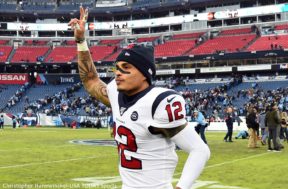
Kenny Stills could be back in the AFC very soon.
Stills is expected to sign with the Buffalo Bills, the Houston Chronicle’s Aaron Wilson reported on Friday.
Former Texans wide receiver Kenny Stills is expected to soon visit and then
ESPN had an unusual broadcasting setup for the Sugar Bowl involving announcers Chris Fowler and Kirk Herbstreit.
Fowler was in attendance for the Allstate Sugar Bowl at Mercedes-Benz Superdome in New Orleans, La. Herbstreit was broadcastin
Notre Dame has been scrutinized heavily for their bad record in big bowl games, and coach Brian Kelly was not happy when that came up again after the team’s loss to Alabama.
The Fighting Irish lost 31-14 to the Crimson Tide in the Co
Video games have been making us laugh for as long as we can remember. Yet often it's by accident rather than design; a result of the player's involvement spoiling the designer's intent.
"You can have this totally serious, heart-wrenching cutscene and the next moment, the player will ruin the mood by falling into a pit or something," Spelunky creator Derek Yu says. "That's why I actually think it's way harder to make a serious game than a comedic game."
Indeed, a game's seriousness can make it all the more amusing when it falls apart: if you've spent any time on the Internet lately, you'll surely have seen the Ghost Of Tsushima clip where protagonist Jin leaps into enemy territory and his body is repeatedly struck by arrows mid-jump, each hit keeping him airborne.
For a better example of a developer clearly understanding the comedic potential of its game, how about the succession of 30-second videos from The Legend of Zelda: Breath Of The Wild that spread across social media, where players found ever more inventively brutal ways of dispatching members of the Yiga Clan? This kind of systemic comedy has become much more prevalent in recent years. And with more games actively using scripted humour as a selling point, it feels as if we're not far away from a new golden age of video game comedy.
Comedy of errors
(Image credit: Valve)
Read more from Edge
(Image credit: Future)
If you want more great long-form games journalism like this every month, delivered straight to your doorstop or your inbox, why not subscribe to Edge here.
Indeed, it's hard to think of a recent triple-A game that has comedy as a central pillar. Both Marshall and Neil refer to Valve's Portal and its sequel as among the funniest games they can remember from that space, but in the latter case that's going back nine years.
"They were amazing and they were big hits," Neil says, exasperatedly. "Why didn't our industry kind of twig from that that they should do more of this stuff?"
There seems to be a misguided belief in some quarters of the industry that seriousness equates to maturity; Yu suggests blockbuster games' obsession with cinema is part of the problem. "A lot of people who don't play games feel like games can't really be art until one can make them cry, and a lot of game designers have taken that to heart."
For Neil, part of the problem is structural – and possibly intractable in some genres. She admits to skipping cutscenes when she plays a lot of modern games, partly because their mechanics are rarely conducive to humour; comedy during cinematics, for example, relies on a player's attention when it's often elsewhere.
"We need mechanics that encourage you to focus on the elements that are core to comedy, like character and shit," she begins. "To notice things in the environment, to notice things about the characters… an audience needs to do a bit of work watching comedy in order to earn the payoff. In a sitcom, you need to see the escalating situation and then you get the punchline in the end, and you've earned that by paying attention. And in action-focused games you're just not paying attention. Games are not very good at that, these long setups and payoffs."
(Image credit: Nyamnam)
Marshall, who has scripted the majority of his games with writing partner Ben Ward, suggests that part of the reason is simply too many cooks; bigger-budget games are much more likely to have a larger team, where jokes are effectively designed by committee.
"I always think about writers' rooms on The Simpsons for like, season 30 or whatever, and how it must just be this hellish environment to get anything approved. With one or two writers, it's probably going to work out a lot better, even if it won't appeal to everyone."
But surely that's preferable to the alternative? "Yeah, I think it's worth the gamble of writing something specific from one or two people, as opposed to all these mediocre jokes that have been approved by everyone where everything gets watered down and filtered down over time."
Nelson Jr attributes it to "confidence and agency", suggesting that "99% of comedy is confidence". He says "you need to believe that its structure, its form and your delivery works. If you don't have that, it doesn't work for anyone. So if you're in a triple-A environment in which your actions are deeply constrained, second guessed or otherwise not enabled to exist with confidence and with autonomy, then you can't expect comedy to thrive in that environment."
All of which, he says, has made him more appreciative when he does play triple-A games that make him laugh. "That means, hopefully, that behind the scenes for that project, someone was allowed to be funny."
(Image credit: Mossmouth)
Meanwhile, for Yu, even the biggest of budgets doesn't necessarily leave room for nuanced facial expressions – we haven't forgotten LA Noire's gurning 'suspicious' faces, as yet another example of accidental comedy. "As realistic as characters look in triple-A games now, they still aren't realistic enough to tell a really funny, scripted punchline. And if you have a triple-A budget, why spend it on cartoon graphics, even if it might be funnier that way? When people pay 60 dollars, they want that extra realism. So part of it is just the pressure of being at that level, at that budget."
But at a lower-budget level, things are changing. As one of the most prolific freelance writers in the industry at present, Nelson Jr has noticed that he and his peers are increasingly being more involved at an earlier stage of a game's production, giving him the kind of tools he needs to deliver better, funnier jokes. He has plenty of experience of projects where that wasn't the case, however.
"I've been in positions alongside other creators where we had to be very funny, but we could not affect who was speaking, what order they were speaking in, when they spoke or the expression that they made when they spoke," he says.
"And our task was to rewrite the entire game because the previous script wasn't funny and was problematic. And the new script needed to be funny, and not a PR nightmare. According to the reviews, at least, we were funny, but as a narrative professional it can be desperately difficult to be funny in circumstances like that, right? Where there's a punchline that would work 1,000 times better if you simply had another option, another capability, if your work was enabled in some way by the team you were working with."
(Image credit: Gearbox)
Game development, he adds, involves a lot of moving parts – and that's where much of the challenge of creating comedy in video games lies. A deep level of collaboration from the start is vital to ensuring that jokes fit the narrative and land as the writer hopes.
"If you don't have the tools to tell a joke, the joke can't be told. If there's not a script in the game that allows me to dramatically zoom in on a character's face, I can't do any joke that involves that. So in many ways, the capability for comedy in a game on any level – systemic or narrative – relies on that capability being supported by the rest of the team in some capacity."
And the reason that happens more in indie games? A broader recognition that with constrained resources, close collaboration is key – even for narrative professionals who write a game's script alone and remotely.
"Having a lot of contact with the team and access to the context in which your words will live… the idea that your work is reliant on that has improved exponentially in the past few years, because there was an age of game writing where you would be given a spreadsheet and that would be it. You wouldn't know if the game was third-person or first-person, if those words would end up in a cutscene or shouted as a bark. You just didn't know."
Mining for laughs
(Image credit: No More Robots)
Comedy is also a relatively cost-effective way to "sex up" a low-budget game, Neil says – and as a former sound designer, she's used to finding cheaper ways to get bang for your buck than graphics. "I think the same thing goes for something like adding humour – it's certainly cheaper than triple-A [games] throwing loads of money at something and then the people in your fine industry rave about framerates or complain about them," she says with a wry smile. "Whatever arms race is going on now… we've got to find a way to compete, right? So it's a cheaper way to make the game appeal."
An effective one, too, Nelson Jr believes, especially in the indie space. In recent years, he's received praise for his words in games that were otherwise poorly reviewed. While he says the potential for truly transcendent interactive comedy remains largely untapped, it is still possible to create games that make players laugh, even if their mechanics are not necessarily tuned for humour.
"You can have a comedy game that's deeply unfunny, but very satisfying on a gameplay level, or deeply unsatisfying on a gameplay level, but actually very funny," he says. "There is a sense of freedom in narrative, at least, where unlike selling the dramatic beat of a character's death when the rest of the game doesn't support that, if I want to make someone laugh due to my specialties, I basically can."
That's part of the reason, he says, that we're seeing much more comedy in indie games these days. "If it can be an isolated piece that can be polished, suddenly you have a forum in which really talented creators and talented narrative professionals can pull something together while working with limited resources that triple-A might not even recognise as being a need in the first place."
(Image credit: Mediatonic)
"The humour can come from absolutely anywhere in video games, and I think that's really exciting."
Dan Marshall
Scripted humour is one approach. But what about those games where the punchline is halfway between deliberate and accidental? "What I think is ace about video games is that humour can come from so many different places," Marshall says. "Dialogue is an obvious way for things to be funny. But then there's something like Fall Guys – I haven't played it yet, but I've been watching a lot of videos of it, and it looks fucking hilarious. And it's not funny because someone's written something funny. There's no jokes in it, as far as I can tell. It's funny for an entirely different reason."
As discussed elsewhere in this issue, Fall Guys was built with physical comedy in mind. Inspired by Takeshi's Castle, this candy-coloured battle royale game is played primarily for laughs – some of them cruel ones, as griefers gleefully push would-be qualifiers out of contention. But the rise of procedural generation has also played a key role in the increasing number of funny games. Marshall says his 2015 stealth-action game The Swindle threw up so many surprise combinations during playtesting that he couldn't contain himself while trying to road-test his own game.
"Spelunky will do it – when completely unexpected stuff just happens. And the world contrives against you. And when you shoot a bazooka in Worms, and it hits a mine and the mine goes dink-dink-dink-dink-dink and lands at your feet and blows up. That's funny, as well. TV can't do that, and films can't do that, and books can't do that. But games can. The humour can come from absolutely anywhere, and I think that's really exciting."
(Image credit: Team17)
Marshall and Nelson Jr both cite Yu's Spelunky as one of the great comedy games because it provides the two things that good comedy needs: surprise and delight. As anyone who has played it will attest, Spelunky is an inherently funny game, its systems frequently colliding in unpredictable ways that naturally lead to moments of unscripted comedy.
There are always happy accidents like these in games with procedural elements, and Yu says he has consciously tried to lean into these during development. "That's a great way to put it, because it's not about planning too much or too far ahead," he says.
"For me, it's better to start by making the individual interactions feel dynamic and let the funny combinations come by themselves. Comedy isn't really the end goal – it's just a product of the world being more deeply interactive. So that's what I focus on."
In making Spelunky 2's world more reactive and alive, he has found new ways and old to boost its comedic potential. "I looked at the first game and thought about which interactions were the most fertile and worth expanding upon," he says. "For example, the tiki man could pick up boomerangs and throw them and that led to some really funny, unexpected situations. Is there more we can do with enemies picking up items? That kind of thing. So in that sense, I did play up the comedy, but in an indirect yet intentional way."
Joke Machine
(Image credit: Size Five Games)
Is it fair to class systemic comedy alongside scripted comedy? When both provoke laughter, surely there's the answer. Though Neil believes the latter is arguably a harder sell these days.
"We're still sort of living with the tyranny of screenshots," Neil says. "It used to be that if you couldn't produce good screenshots of your game, then you're doomed. But now it's videos, animated GIFs and stuff. Anything that's not art has a real disadvantage."
Marshall, who has pivoted from a dialogue-heavy game to one that's more immediately "GIF-able", in which a playable dinosaur tosses around the humans trying to hunt it – agrees.
"It was like getting blood from a stone getting anyone to pay attention to Clockwork God, and I think that's partly because it's not an internet-friendly or social media-friendly type of game. In a game like that, even with a line of dialogue that's technically funny, it's only really funny because of a wealth of stuff that comes before it."
That's why, he says, the game's trailer didn't have any dialogue. "Taken out of context and just banged in a trailer, everything felt really try-hard and forced and fake and false. But when you're playing it and you're like an hour deep, it's funny. You've got all these pillars in-game, and the writing part is such a wobbly pillar. You and I could look at it and think, 'That is a fucking funny pillar,' and then someone at a slightly different angle sees it wildly differently, and it all comes crumbling down. But that's the nature of the beast."
(Image credit: Sega)
Nelson Jr, however, thinks that no type of comedy is more successful or inherently accessible then another, citing the Yakuza games as an example.
"Its localisation team rightly gets some of the greatest kudos in games, because they have written around the capabilities of a dialogue box," he says. "Most of the time, their audience is looking at that dialogue box and they're taking pictures of that and they're sharing it on social media – in or out of context it's funny. On the other hand, you've got things like Fall Guys where the chaos is organic, and compelling from an image. It's comedy either way."
While things are clearly improving, Neil thinks games have a way to go before a large audience approaches the medium actively looking for something to make them laugh. "The biggest thing for me is really the low expectations. If you're looking for a comedy experience, you say, 'I feel like watching a funny movie', or 'I feel like watching some TV,' you know? 'Or I'm going to go out and see some standup.' I'm not going to go looking for that kind of experience [in games] because I don't expect it."
Nelson Jr thinks the situation may become easier as more commercially successful comedy games are released. As a writer, he says, it encourages him to suggest more comedic ideas whenever the opportunity arises.
"It gives you an argument inside the room to say, 'Hey, everybody loved that sassy android in Call Of Duty: Infinite Warfare. Can I make this android sassy?'" Yet he wouldn't say there's an increased appetite for comedy games these days, simply that there are now more ways to fulfil the need to laugh. "We're just seeing more and more avenues for that desire to be satisfied, because that desire is inherently human."
(Image credit: Activision)
But can video games do that and still be mechanically satisfying? The funniest games often have very straightforward systems, for one simple reason. If the secret to good comedy is timing, then it's hard to achieve that when agency is ceded to the player, when they have control over the delivery of a joke.
Necrophone Games' first-person spy adventure Jazzpunk strove to subvert player expectations at every turn, ensuring similar interactions always had different, unlikely outcomes. It remains one of the funniest games Edge has played, yet few have followed its lead. Developers like Amanita Design, meanwhile, have had success mimicking the point-and-click formula, but making their games wordless, while introducing elements of vaudeville and surrealism. The unexpected responses to your actions in the likes of Chuchel and Pilgrims, for example, provide the moments of surprise that make them funny. Even if, ultimately, your only involvement is to click on a person, object or sentient jelly. It's something Neil has been thinking about lately.
"A player wants agency," she says. "And if they can have agency in the creation of comedy, I think that's definitely like a good thing to aim for. You know, when people are playing with The Sims and then locking their Sims in houses and then burning them to death – I don't know why I brought that example up – but at that sort of meta level, right? I think we actually make the mistake in games of working at this micro level of saying, 'Oh, and now I'm going to give the player three options for the punchline,' and for me that's not how comedy works. It's about pacing and surprise, and I think we're going to always be limited in games if we take current mechanics like a conversation tree, and just inject comedy."
(Image credit: Necrophone Games)
Instead, she says, games should start with comedy and then find mechanics that flow from that. Only then can we start thinking about comedy becoming its own genre in games, rather than merely an added bonus.
"We're at a stage of technology where we've done the whole jerk off to graphics thing, we've done wanking over the physics stuff, people talk about AI and procedural content generation, but I think now we're at a time where we've got the tools to actually start realising the potential of interactive comedy."
"There's Double Fine, there's Crows Crows Crows, there are indie studios – but why can't I name more big studios that are great at comedy? I mean, for god's sake, we have specialist racing game studios! Why is this not a massive genre in games? The time is right and the time is now."
This feature first appeared in Edge Magazine. For more excellent features, like the one you've just read, don't forget tosubscribeto the print or digital edition at Magazines Direct.
cucun.indah.link Sign up for the Guardian’s First Thing newsletter
Donald Trump’s presidency will soon come to an end, and his time in the White House will almost certainly be best remembered for the chaos and controversy caused by his oft-criticized choices on everything from immigration to the coronavirus pandemic.
These moments have often sparked widespread alarm, such as when Trump incorrectly suggested Americans could protect themselves from coronavirus by ingesting disinfectants.
But some of those Trumpian moments have been so obviously ridiculous that Americans had no choice but simply to laugh.
Here are 10 purely comedic moments from the Trump presidency:
1. When Trump stared at the solar eclipse. Way back in August 2017, Americans across the country stopped in their tracks to view the rare total solar eclipse. In the days before the celestial event, ophthalmologists turned to everypossiblenewsoutlet to share this urgent warning: do not stare at the sun without protective eyewear. But those dozens of warnings did not stop one man, our commander-in-chief, from doing just that.
Donald Trump points to the sun as he arrives to view the solar eclipse at the White House. Photograph: Andrew Harnik/AP
2. When Trump came up with “covfefe”. The Trump era has been marked by the introduction of a number of new words and phrases, such as “fake news”, “alternative facts”, “bigly” or, as he argued, “big league”. But arguably the most nonsensical of all is “covfefe”, the made-up word that Trump included in a 2017 tweet complaining about news coverage of his administration. “Despite the negative press covfefe,” Trump wrote in the incomplete tweet. The president quickly deleted the tweet, but the word had already spawned thousands of Twitter jokes.
3. When Trump yelled at a boy mowing the White House lawn and became a meme. It all began with a letter to the White House. Frank Giaccio, a 10-year-old from Virginia, said in his letter to Trump that he had started his own lawn-mowing business and wanted to make the White House one of his clients. In September 2017, Giaccio got his wish.
As Giaccio mowed the White House lawn, the president stepped out to commend him for his entrepreneurial spirit, apparently trying to shout over the sound of the lawnmower. The resulting photo sparked a meme that was deployed for every major controversy over the rest of Trump’s presidency.
4. When Trump and two other world leaders stood around a glowing orb. Trump’s 2017 trip to Saudi Arabia gave the world one of the most enduring images from his presidency. While visiting an anti-extremist center in Riyadh, Trump, King Salman and the Egyptian president, Abdel Fatah el-Sisi, placed their hands on a glowing orb. The resulting photos of the three leaders standing around a lit sphere, looking as if they were planning global destruction, prompted a widespread reaction of, “Wait, what?”
Donald Trump places his hands on a glowing orb as he tours the Global Center for Combatting Extremist Ideology in Riyadh, Saudi Arabia. Photograph: Reuters Tv/Reuters
5. When Anthony Scaramucci was fired after 11 days as White House communications director. The rapid rise and fall of “the Mooch” across 11 days in 2017 was an early indication of the chaos that would define Trump’s staffing strategy. Scaramucci was let go after a foul-mouthed tirade to the New Yorker, including referring to the then chief of staff, Reince Priebus, as “a fucking paranoid schizophrenic”.
The communications director was pushed out by the newly installed chief of staff, John Kelly, who was also dismissed a little over a year later. After his short White House stint, Scaramucci became a fierce critic of the president and took to using the short length of his tenure as a measurement of time.
Anthony Scaramucci(@Scaramucci)
Tomorrow starts the last Scaramucci (11 days) of the race.
6. When Trump waxed poetic about a steelworker’s late father, who was very much alive. During a 2018 event at the White House, Scott Sauritch, the president of a steelworkers union in Pennsylvania, thanked Trump for imposing tariffs on steel imports. Sauritch noted his father, Herman, lost his job because of steel imports.
The president told Sauritch, “Well, your father Herman is looking down. He’s very proud of you right now.” Sauritch replied, “Oh, he’s still alive.” Trump tried to recover by saying, “Well then, he’s even more proud of you.”
7. When Trump asked a seven-year-old girl whether she “still” believed in Santa Claus. When Collman Lloyd contacted the North American Aerospace Defense Command to track Santa’s whereabouts in 2018, the young girl probably didn’t expect to speak to the president – or to be quizzed on her beliefs.
Trump asks seven-year-old girl if she still believes in Santa – video
The president and the first lady were taking calls patched through from Norad on Christmas Eve to speak to children wondering where Santa was on his journey around the world. Trump asked Lloyd, “Are you still a believer in Santa? Because at seven it’s marginal, right?”
8. When Trump wanted to buy Greenland. After the president confirmed last year that he was toying with the idea of trying to purchase Greenland, the internet jumped to assist him, envisioning a Trump Tower on the island and suggesting a potential price point for the transaction. But some people, namely residents of Greenland, did not find the outlandish suggestion to be quite as funny, so Greenland’s leadership issued a statement making it clear that the island, a semi-autonomous Danish territory, was “not for sale”.
Greenland MFA 🇬🇱(@GreenlandMFA)
#Greenland is rich in valuable resources such as minerals, the purest water and ice, fish stocks, seafood, renewable energy and is a new frontier for adventure tourism. We're open for business, not for sale❄️🗻🐳🦐🇬🇱 learn more about Greenland on: https://t.co/WulOi3beIC
9. When Trump claimed “fake news” over a picture of his tan line. While returning to the White House from a trip to North Carolina in February, photographers captured a picture of Trump that showed a noticeable tan line on the president’s face.
Donald Trump walks across the South Lawn as he returns from North Carolina on 7 February 2020. Photograph: Joshua Roberts/Reuters
A different version of the photo, which appeared to exaggerate the tan line, later went viral on Twitter, sparking comparisons to Mrs Doubtfire and Wilson the volleyball from Cast Away. Trump couldn’t help but weigh in, writing in a tweet, “More Fake News. This was photoshopped, obviously, but the wind was strong and the hair looks good? Anything to demean!”
10. When Trump’s campaign held a press conference at Four Seasons Total Landscaping in Philadelphia. Hours before Joe Biden was declared the winner of the presidential election, Trump sent a tweet saying his campaign would hold a press conference at the Four Seasons in Philadelphia. But he then sent another tweet, clarifying that the event would actually take place at Four Seasons Total Landscaping, a Philadelphia groundskeeping business located between a crematorium and a sex shop.
Donald J. Trump(@realDonaldTrump)
Big press conference today in Philadelphia at Four Seasons Total Landscaping — 11:30am!
The mix-up was a major embarrassment for Trump advisers like Rudy Giuliani, who was forced to peddle his baseless claims about election fraud in a parking lot. But it was a huge success in terms of Twitter jokes and merchandising opportunities for the previously little-known landscaping company.
Patton Oswalt(@pattonoswalt)
This is not over. For we shall mount our righteous stand at Four Seasons Total Landscaping. Next to Fantasy Island Adult Books. Across the street from the Delaware Valley Cremation Center. Between the fire extinguisher and yellow hose. #MAGApic.twitter.com/hxuAsbEjXi
RICHMOND, Va. -- A Richmond educator who was named the best teacher in America last year has apologized for a social media posting that seemed to encourage violence against Senate Majority Leader Mitch McConnell.
“Who are Mitch McConnell’s neighbors?” Rodney Robinson tweeted Wednesday. “I’m just saying Rand Paul’s neighbor did what a true Kentucky hero should do. It’s your turn to step up.”
Senator Rand Paul was assaulted by one of his neighbors in 2017. He suffered six broken ribs and had to have part of his lung removed.
Paul’s wife later responded saying she was disgusted by the tweet and flagged it to Jack Dorsey, the head of Twitter.
Robinson has since deleted the tweet, and he has posted an apology on his Medium website Thursday morning.
“I recently made a bad joke on Twitter about Rand Paul’s fight with his neighbors in relation to Mitch McConnell’s neighbors and I was wrong for that,” the statement reads, in part. “No one should be assaulted. Due to my ignorance of the situation, I didn’t know Rand Paul was seriously injured in the altercation. I apologize for making light of his injuries. I do not advocate for violence against Mitch McConnell.”
Robinson was named the National Teacher of the Year in 2019. At the time, he taught history to students inside the Richmond Juvenile Detention Center.
Earlier this year, he was named senior adviser for Richmond Public Schools. He is also a member of Richmond Mayor Levar Stoney’s Education Compact Team and the Task Force to Reimagine Public Safety.
WTVR CBS 6 reached out to Richmond Public Schools (RPS) for a statement. Officials pointed to a tweet from RPS Superintendent Jason Kamras posted Thursday morning.
“RPS doesn’t condone violence of any kind. Period,” Kamras’ tweet reads. “Thank you to Rodney Robinson for this heartfelt apology. Words matter – across the political spectrum.”
A new year and hopefully a better one for many. (Picture: Getty)
‘Ring out the old, ring in the new, Ring, happy bells, across the snow: The year is going, let him go; Ring out the false, ring in the true.’ A bit of Lord Tennyson to start the New Year’s Eve celebrations off with a high-brow tone.