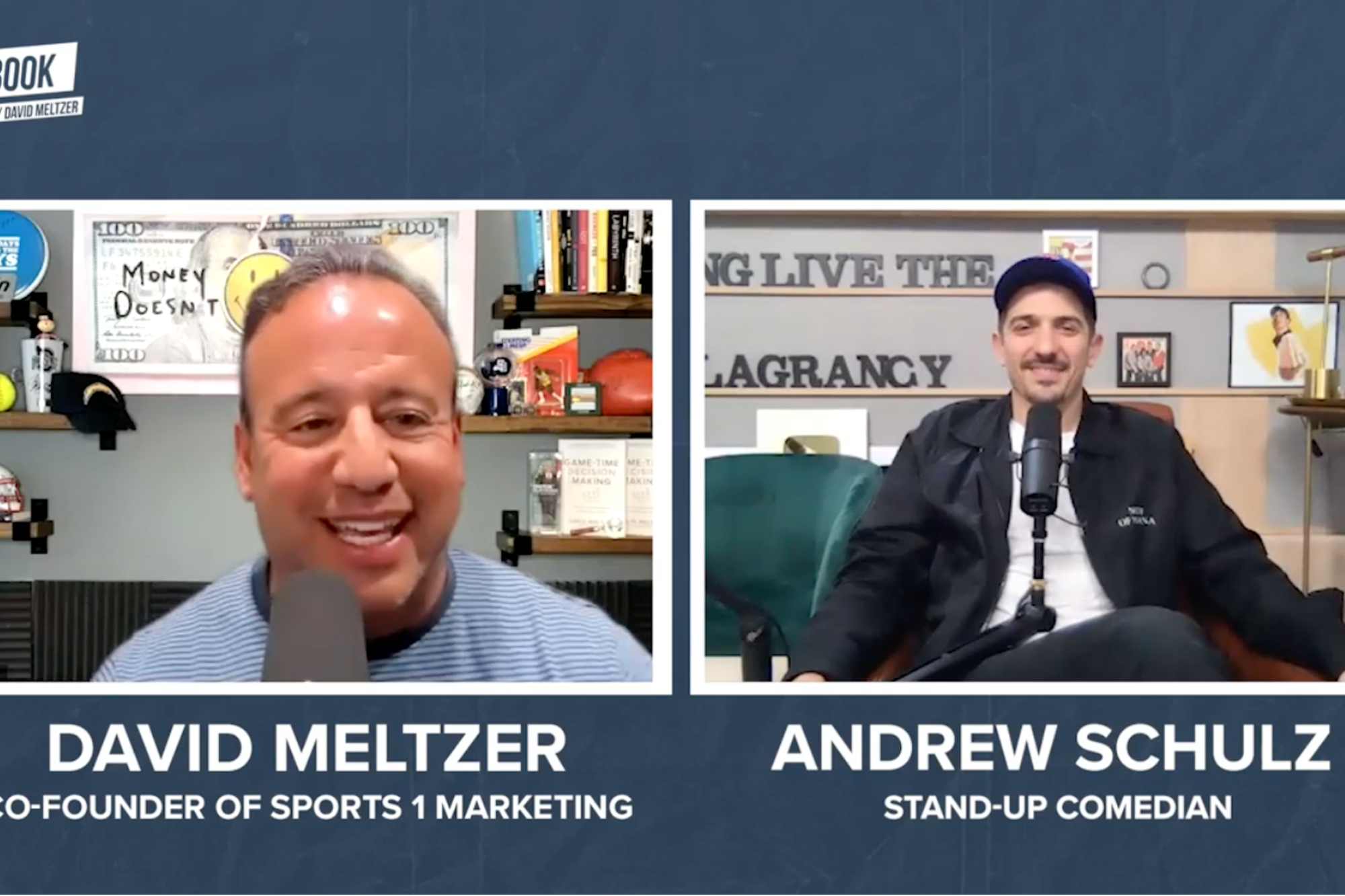
Comedian and podcaster Andrew Schulz talks about his approach to comedy and why he's never afraid of being controversial.
Entrepreneur's New Year’s Guide
Let the business resources in our guide inspire you and help you achieve your goals in 2021.
1 min read
Opinions expressed by Entrepreneur contributors are their own.
Andrew Schulz is a comedian, podcaster and host of the Netflix special Schulz Saves America. In this episode of #ThePlaybook, Schulz talks with host David Meltzer about cancel culture, Netflix and internet commenters.
Schulz talks about how cancel culture is a way for individuals to make corporations “bend the knee,” but isn’t about the content creators themselves. He explains that entertainment companies including Netflix are targets for complaints because they have to appeal to and please everybody simultaneously.
Schulz also talks about how internet outrage garners attention for comedians, and how he uses internet trolls to promote his content.
HuffPost is part of Verizon Media. We and our partners will store and/or access information on your device through the use of cookies and similar technologies, to display personalised ads and content, for ad and content measurement, audience insights and product development.
Your personal data that may be used
Information about your device and internet connection, including your IP address
Browsing and search activity while using Verizon Media websites and apps
To enable Verizon Media and our partners to process your personal data select 'I agree', or select 'Manage settings' for more information and to manage your choices. You can change your choices at any time by visiting Your Privacy Controls.
Welcome toFix It, our weekly series examining projects we love — save for one tiny change we wish we could make.
We’re the Millers is a great movie with just one scene to “ragret.”
Director Rawson M. Thurber (aka the dude who brought you Dodgeball) delivered a timeless monument to joke writing excellence with his 2013 road trip comedy starring Jason Sudeikis, Jennifer Aniston, Emma Roberts, and Will Poulter. The hilarious, yet oft-maligned flick — which has a 48% on Rotten Tomatoes, but an A- on CinemaScore — tells the story of a small-time drug dealer (Sudeikis) teaming up with a stripper (Aniston), a misfit teen (Roberts), and a dweeb (Poulter) to smuggle marijuana from Mexico into the great state of Colorado. (Lol, 2013.)
By posing as a family of tourists, the four unlikely conspirators plan to trick border agents into letting them through customs riding an RV filled headlights-to-tailpipes with highly potent weed.
We’re the Millers is a great movie with just one scene to “ragret.”
It’s a simple premise executed remarkably well. Nearly 8 years later, We’re the Millers’ quick-witted dialogue and stellar casting continues to make it a worthwhile watch, immortalized on social media through its most quotable lines and meme-able moments. “Wait, you guys are getting paid?” is, of course, an all-time great.
Still, there’s one scene, arguably one of the film’s most iconic, that hurts its otherwise great composition. Yep, I’m talking about Jennifer Aniston’s nearly two-minute strip performance to Aerosmith’s “Sweet Emotion.” It’s a notorious sequence that was almost universally knocked by critics when We’re the Millers came out — but not for the reasons it should have been.
Jennifer Aniston is absolutely NOT the reason this scene didn't work.
Image: warner bros.
I'll admit, the scene (which involves Aniston’s character Rose doing an elaborate strip tease as a distraction for an escape plan) is objectively ridiculous.
It's a classic example of a joke gone wrong — an instance where the "straight man" delivered and the comedian didn't.
Set in a remote warehouse, the exquisitely choreographed number sees Rose sexily scale an industrial ladder, douse herself with water in a safety shower, and inexplicably start a small fireworks display with the push of a button — all while dancing in her underwear. Rose’s fake family and the gangsters holding them hostage look on in awe at the smoking hot strip tease, until Rose blasts the main bad guy with some steam and the group makes a hasty getaway.
In 2013, plenty of jerks used the sexy spectacle as an excuse to shame Aniston about everything from her feminist values to her weight. The sequence, heavily featured in the trailer, was largely regarded as a tasteless ploy to sell tickets. A critic for Time Out described Aniston's performance as “desperate-looking,” and another for the New York Times mused that it was taken on by the actor solely to "prove to the world that she has an amazing body." That sort of language, placing the failed joke squarely on Aniston’s shoulders and not on the rest of the creative team behind We’re the Millers, was a trend throughout reviews that was at best misguided and at worst akin to slut-shaming.
But the issue with this sequence, at least as I see it, has very little do with Aniston. Instead, it's a classic example of a situational joke gone wrong — a time when the "straight man" (in this case, Aniston) delivered and the comedian opposite her (in this case, the gobsmacked onlookers played by Sudeikis, Roberts, and Poulter) did not.
David! Give! Me! Something! Else! PLEASE!
Image: warner bros.
During the scene, Aniston plays the strip tease with total sincerity. There's no slapstick comedy or snarky remarks. It's just hot, top to (extremely toned) bottom. But with a staggering duration of almost two minutes — a hell of a long time for a sub-two hour movie — We're the Millers doesn't take enough comedic swings to make the most of the overtly funny situation. It's a shortcoming that tanks the scene and drags down the second half of the film.
These jokes are, in a word, fine. But they don't measure up.
Just two jokes, count 'em two, occur during the scene: (1) At the start of the strip tease, Sudeikis' character David does a straight-to-camera The Office-style eyebrow raise, as if to say "Can you believe this?" and (2) At the end of the strip tease, Poulter's character Kenny gets a boner and David says, "Have some respect. That's your mother!"
These jokes are, in a word, fine. But for a script that boasts Poulter cupping a pair of swollen testicles and crying "A SPIDER BIT ME ON MY BALLS!", they don't measure up.
See, Aniston's dance, which took two months of training and required a stunt double, is so well done that it heightens the comedic tension to a point where a slam-dunk joke is required — or else, the scene comes out like it did: an awkwardly titillating outlier in an otherwise not sexy movie. It's so sexy you need something to cut that tension, and a couple of half-baked jokes just don't do it.
What's worse, the energy of both of David's lines have a distinct "What're we even doing here?" tone. It's clear these were intended to be moments of self-aware comedy, underscoring the rest of the R-rated film's raunchy vibe. But, as the scene turned out, they're missed opportunities, dragging down the energy of Aniston's incredible performance with a sense of bizarre disinterest.
In effect, these half-hearted one-liners reverse the roles that would have made this scene work. It forced Aniston's not at all funny routine to be the punchline when it should have been the setup, and made Sudeikis' lines accessories to that joke's bad execution. Aniston's performance gets labeled unnecessarily suggestive and Sudeikis' wry character, who kills in almost every other scene of the movie, appears inconsistent if not a bit lazy.
Slay them, Jen. SLAY. THEM.
Image: warner bros.
Whether punching up these jokes would have calmed We're the Millers' most aggressive critics, I can't say. Still, I'd like to think fixing this scene would have helped the rest of this phenomenal movie shine as brightly as it ought to — or at least saved Aniston some undeserved hate.
All I'm saying? Make those jokes as tight as Jen's abs and you've got a winner, baby.
Content warning: This article discusses topics around sexual assault that may be triggering for some readers.
I will never understand the appeal of making rape jokes.
When I was a college freshman, I was sexually assaulted. I was 17, bubbly and chipper, and ready to take on my newfound freedom away from home. I was disappointed it took such a turn within the first week.
Since becoming a member of the sexual assault survivors club, it’s been a rocky road. In the beginning, it felt like my entire life was falling apart, like this was my punishment from the universe for every fault or mistake I’ve made in life.
Although it has been about a year and a half since it happened, I still have triggers that bring me right back to that moment. Most recently, I saw talk about the actor Armie Hammer, who had disturbing Instagram direct messages surface detailing his cannibalistic desires, as well as several women coming forward accusing him of sexual assault or coercion.
Social media users were making jokes about the allegations against Hammer. Some jokes were made at the expense of Hammer, and some at the expense of the victims. Regardless, these were jokes that garnered likes, laughing emojis and keyboard smashes in the comments. People were making jokes at the expense of every single person who’s ever been sexually assaulted.
Not only can these jokes be extremely triggering for sexual assault survivors, but they also downplay the severity of rape and sexual assault. Cracking a lighthearted joke about sexual assault frames it as being less serious than it really is.
Rape culture is so ingrained in our society that it’s normal to make rape jokes. If you don’t laugh, then you just “can’t take a joke.” Some of the most well-known comedians, like Dave Chapelle, who had a stand-up segment about male rape, have gained their fame from poking fun at the trauma of others. This shows just how much this behavior is normalized and celebrated.
Every time I hear a sexual assault joke, my heart falls into the pit of my stomach. It feels like a sick inside joke that I’m not a part of. Once I muster up the courage to speak up about it, suddenly I’m a snowflake that’s too sensitive to understand “edgy” or “dark humor.”
I am admittedly no expert on the topic, but I was always under the impression that dark humor is supposed to be funny. Poking fun at the trauma of others for shock value is not funny and never will be.
The jokes are still despicable even if you think no one you’re saying it to is a survivor. Although I’ve told most of those closest to me about what happened, many in my life are still unaware of what I went through.
Hearing sexual assault jokes is painful, like someone is stabbing into my wound that was just on the brink of healing. Every “joke” is another jab, and seeing how pervasive rape culture still is today, it looks like my wound will never close.
Content warning: This article discusses topics around sexual assault that may be triggering for some readers.
I will never understand the appeal of making rape jokes.
When I was a college freshman, I was sexually assaulted. I was 17, bubbly and chipper, and ready to take on my newfound freedom away from home. I was disappointed it took such a turn within the first week.
Since becoming a member of the sexual assault survivors club, it’s been a rocky road. In the beginning, it felt like my entire life was falling apart, like this was my punishment from the universe for every fault or mistake I’ve made in life.
Although it has been about a year and a half since it happened, I still have triggers that bring me right back to that moment. Most recently, I saw talk about the actor Armie Hammer, who had disturbing Instagram direct messages surface detailing his cannibalistic desires, as well as several women coming forward accusing him of sexual assault or coercion.
Social media users were making jokes about the allegations against Hammer. Some jokes were made at the expense of Hammer, and some at the expense of the victims. Regardless, these were jokes that garnered likes, laughing emojis and keyboard smashes in the comments. People were making jokes at the expense of every single person who’s ever been sexually assaulted.
Not only can these jokes be extremely triggering for sexual assault survivors, but they also downplay the severity of rape and sexual assault. Cracking a lighthearted joke about sexual assault frames it as being less serious than it really is.
Rape culture is so ingrained in our society that it’s normal to make rape jokes. If you don’t laugh, then you just “can’t take a joke.” Some of the most well-known comedians, like Dave Chapelle, who had a stand-up segment about male rape, have gained their fame from poking fun at the trauma of others. This shows just how much this behavior is normalized and celebrated.
Every time I hear a sexual assault joke, my heart falls into the pit of my stomach. It feels like a sick inside joke that I’m not a part of. Once I muster up the courage to speak up about it, suddenly I’m a snowflake that’s too sensitive to understand “edgy” or “dark humor.”
I am admittedly no expert on the topic, but I was always under the impression that dark humor is supposed to be funny. Poking fun at the trauma of others for shock value is not funny and never will be.
The jokes are still despicable even if you think no one you’re saying it to is a survivor. Although I’ve told most of those closest to me about what happened, many in my life are still unaware of what I went through.
Hearing sexual assault jokes is painful, like someone is stabbing into my wound that was just on the brink of healing. Every “joke” is another jab, and seeing how pervasive rape culture still is today, it looks like my wound will never close.
In many ways, the world was a different place when Saturday Night Live went on its winter hiatus last year. While the show has been off the air, we’ve experienced an insurrection at the Capitol, an impeachment (again), the inauguration of a new president and some stock market goofiness that feels straight out of The Wolf of Wall Street. Naturally, when the sketch comedy show made its return on Saturday night with host John Krasinski, viewers were eager to see how it would tackle the slew of major news stories it missed while it was away.
While the show did address some of those current events in its cold open, Krasinski’s monologue felt trapped in the past. Using the “audience Q&A” format the show often relies on for host monologues, the general premise was everyone confusing Krasinski for Jim, his popular character from The Office, with Kenan Thompson appearing at one point and insisting that the host “kiss Pam.” (The Office debuted in 2005 and has been off the air since 2013, so jokes about people confusing Krasinksi for his character feel a little stale.)
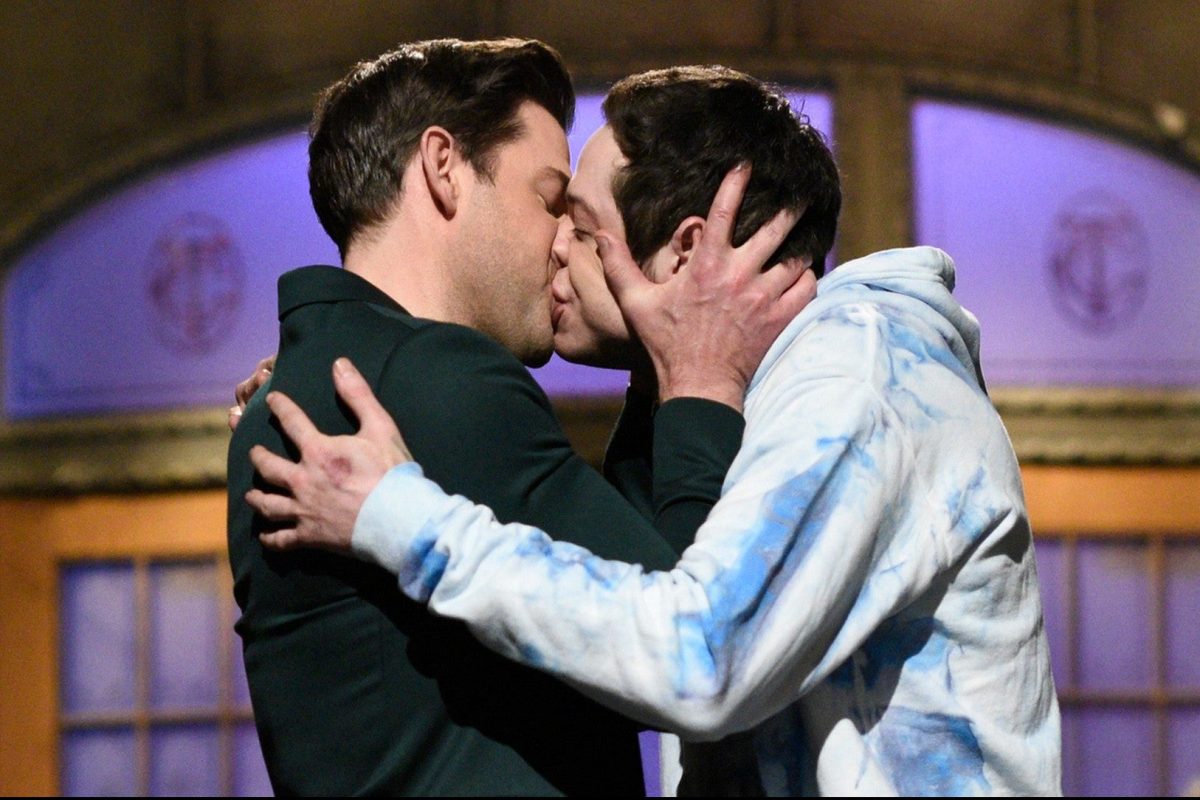
Eventually, Pete Davidson appeared to try to explain why the show was doing a Jim-and-Pam bit in the year 2021 (and perhaps subtly plug the fact that The Office is now exclusively streaming on NBC’s Peacock service): “I think what’s happening is everyone’s been stuck inside for a year watching The Office non-stop so Jim and Pam are, like, really real for them,” he said. That, of course, prompted Thompson to ask if Davidson was Pam, resulting in the comedian and host deciding to just give the people what they want and smooching to end the monologue.
Get it?? They’re two straight men, but they KISSED! Again, it’s 2021 — why is Saturday Night Live still using two men kissing as a punchline? The show has a long, sad history of using same-sex kisses for laughs, but it’s especially disappointing that it continues to this day. What exactly is the intended joke here? Would the bit make sense if Davidson was swapped out for, say, Cecily Strong or another female cast member? SNL acts as though two men kissing on television is somehow shocking or edgy, but it hasn’t been for at least 25 years. Bits like these were already lazy and unfunny when they were still commonplace in the early aughts.
If your TV show thinks a same-sex kiss is edgy, it might need to A) climb out of 2003; B) get new writers; or C) both. #SNL
Jokes that are rooted in homophobia are always a disappointment, but Saturday Night Live‘s latest feels especially egregious now given that the show currently has two openly gay cast members, Kate McKinnon and Bowen Yang, and regularly tries to position itself as a more open-minded alternative to the conservative viewpoints it so often satirizes. How must McKinnon and Yang feel to watch their coworkers still engaging in same-sex kisses as a joke?